
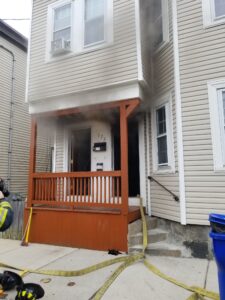
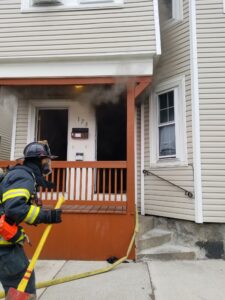
Photo credits Paul Koolloian
Article by ebyam
“Advancing a deflated hose-line is faster and easier than a charged line. When the deflated hose-line reaches the fire area, the water should be ordered” (Smith, J., Strategic & Tactical Considerations on the Fireground, 2016, p. 120)
Stretching uncharged (i.e., dry) hoselines is both advantageous and practical. Making entry into a fire building without expending precious time, energy or air can greatly impact the speed at which confinement or extinguishment of a fire is achieved.
Tactics are largely dictated by circumstance: staffing and length of lay must be taken into account when considering when the nozzle firefighter (i.e., “pipeman”) should call for water. Having to advance a charged hoseline up multiple flights of stairs, through multiple doors, and navigate an unknown number of bends and turns while a fire is in the free burning stage only allows conditions to worsen and more resources to be needed. Attempts should be made to get as close as possible to the seat of the fire prior to calling for water, and firefighters should draw on their experience, training, and feel when determining what point that is.
Ensuring safety is paramount. Factors to consider when stretching dry include:
• Do not bypass fire, as this could lead to hoselines being burned and routes of egress cut off.
• Monitor the ceiling for falling debris or compromised members.
• Stairwells offer a protected area below the thermal layer to charge the line.
• Controlling interior and exterior doors limits the spread of fire and confines it while the hoseline can be charged.
• If not stretching a pre-measured hoseline, know where you’re going and expect to be as well as potential obstacles when anticipating the length of the stretch.
Recent Comments